




The Hygrothermograph
A hygrothermograph is a mechanical instrument that continuously records both relative humidity and ambient temperature on a single rotating 7-day chart. At Hess Persson Estates in Napa Valley, one sits quietly in The West Gallery of the Hess Art Museum. There, it helps protect a contemporary art collection that includes works by Francis Bacon, Andy Goldsworthy, and Frank Stella. Invented in the late 19th century, hygrothermographs remain prized by museum conservators for their remarkable accuracy and analog reliability. There are no batteries, no software, and no signal drift.
How a Hygrothermograph Works
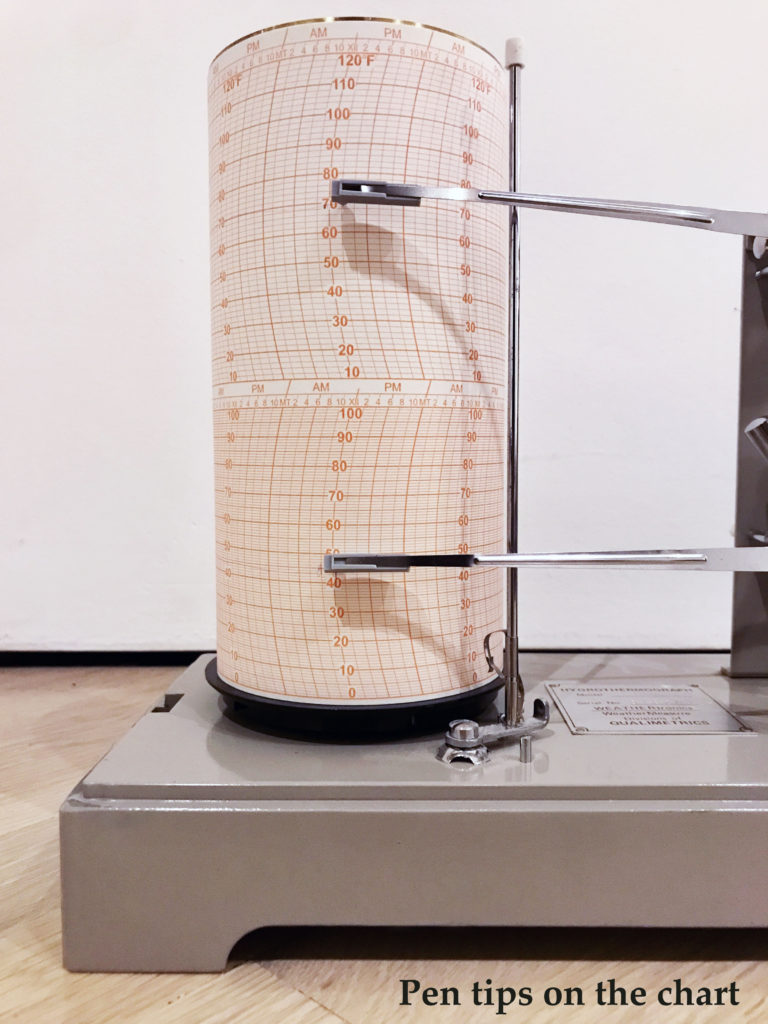
The instrument captures two readings at once using two independent mechanical arms. Each is tipped with a pen that traces a continuous line onto graph paper wrapped around a slowly rotating drum. The drum completes one full rotation every seven days. As a result, it produces a week-long visual record of climate conditions inside the gallery.
What makes the device remarkable is that both measurements rely entirely on the physical properties of natural materials. In fact, there are no electronics involved.
The Humidity Arm: Powered by Human Hair
The humidity-measuring arm is controlled by a bundle of human hair strands, which expand and contract as relative humidity rises and falls. It’s the same reason your hair tends to curl or frizz when it rains. Human hair is naturally hygroscopic, lengthening by roughly 2–3% between dry and humid conditions.
The hair bundle is mechanically linked to a pen that translates these tiny length changes into a continuous line on the chart. The result is a humidity reading accurate to within ±3% relative humidity — well within the tolerance museum conservators need.
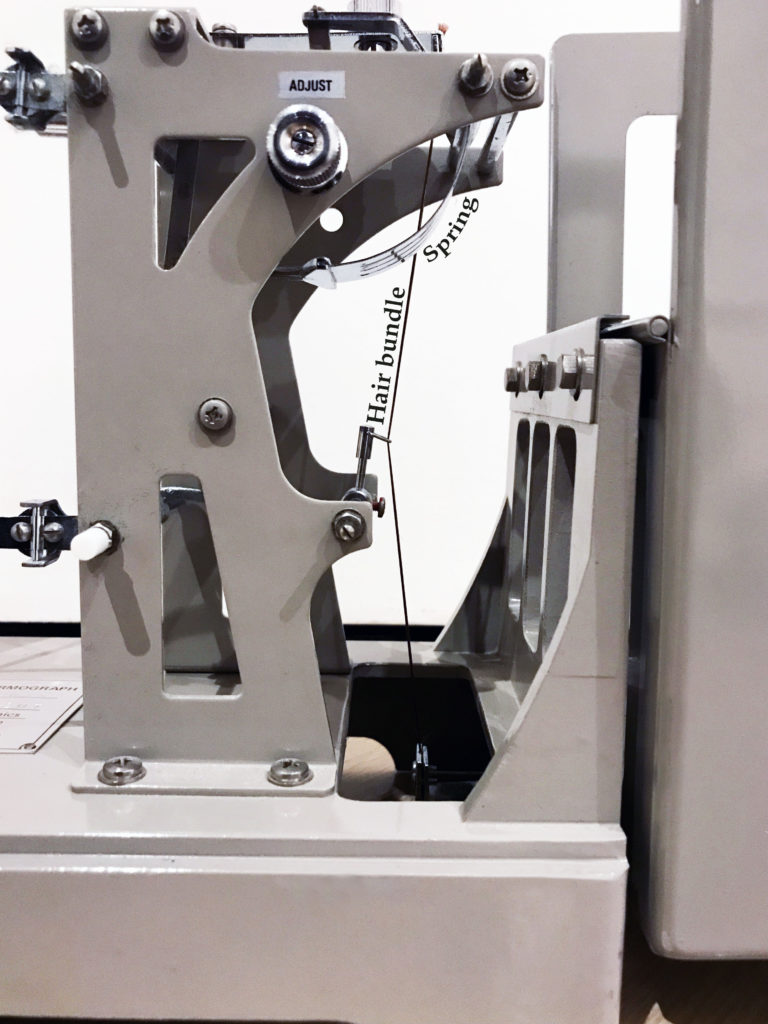
The Temperature Arm: A Calibrated Spring
The temperature arm uses a bimetallic spring that expands and contracts predictably with ambient temperature. Like the humidity arm, it’s connected to a pen that draws an unbroken line as conditions shift through the day. Furthermore, when calibrated correctly, the temperature reading holds accuracy within ±0.5°C.
Together, the two lines produce a week-long climate fingerprint of the gallery — instantly readable at a glance, archivable indefinitely on paper.
Why Climate Control Matters for Fine Art
Museum conservators generally target a stable environment of 45–55% relative humidity at 65–70°F (18–21°C) for mixed-media collections. Sudden swings are more damaging than the absolute values. For example, rapid humidity changes can crack paint, warp wood panels, loosen canvas, and accelerate the corrosion of metal sculpture.
A hygrothermograph doesn’t control the climate — that’s the job of the HVAC system — but it provides the visible, continuous record that tells us whether the system is doing its job. When something drifts, the chart shows it before the artwork ever does.
A Familiar Discipline at a Napa Winery
There’s a reason this instrument feels at home at a winery. The same principles that protect fine art also govern how we age wine. Our barrel cellar and production technology are built around tight environmental tolerances. This is because oak barrels and aging wine respond to humidity and temperature swings much the way canvas and pigment do. Whether the medium is a Goldsworthy installation or a Cabernet Sauvignon resting in French oak, the work is the same. In short, keep the environment stable, and the material reveals its best self over time.
See the Hygrothermograph in Person
The hygrothermograph is one of many unexpected corners of the Hess Art Museum that surprise visitors during a tasting at Hess Persson Estates. The gallery is free to visit and open Thursday through Monday, 10:00 AM to 4:30 PM, alongside our tasting room at 4411 Redwood Road in Napa.
Plan a visit and tasting experience to see it for yourself. Alternatively, explore more of the Hess Art Collection online.
Frequently Asked Questions
What is a hygrothermograph?
A hygrothermograph is a mechanical instrument that simultaneously records relative humidity and ambient temperature on a continuous 7-day paper chart. It uses no electronics. Humidity is measured by strands of human hair, and temperature by a calibrated bimetallic spring. Museums and archives have used hygrothermographs since the late 19th century for climate monitoring.
How does a hygrothermograph measure humidity?
A hygrothermograph measures humidity using a bundle of human hair strands, which expand and contract roughly 2–3% in length between dry and humid conditions. The hair bundle is mechanically linked to a pen that traces humidity changes onto a rotating chart. As a result, it produces a continuous 7-day record accurate to within ±3% relative humidity.
Why do museums use hygrothermographs?
Museums use hygrothermographs to maintain a continuous, tamper-proof record of gallery climate conditions. Because the instrument is fully mechanical, it keeps recording during power outages and software failures. Conservators rely on the 7-day charts to detect humidity and temperature swings that could damage paintings, wood panels, textiles, and metal sculpture.
What humidity level is ideal for protecting fine art?
Most museum conservators target 45–55% relative humidity at 65–70°F (18–21°C) for mixed-media collections. Stability matters more than the exact value. Rapid humidity swings can crack paint, warp panels, loosen canvas, and corrode metal artworks faster than steady conditions at the high or low end of the range.
Where can I see a hygrothermograph in Napa Valley?
A working hygrothermograph is on display in The West Gallery of the Hess Art Museum at Hess Persson Estates, 4411 Redwood Road, Napa, CA 94558. The gallery is free to visit and open Thursday through Monday, 10:00 AM to 4:30 PM, alongside the Hess tasting room.
Are hygrothermographs still accurate compared to digital sensors?
Yes — properly calibrated hygrothermographs remain accurate to within ±3% relative humidity and ±0.5°C, comparable to many digital data loggers. Museums continue to use them because they require no power, no firmware, and produce a permanent paper record that can be archived indefinitely without risk of data loss.